
NTU HCI Lab
台大人機互動實驗室
研究影響力獲 Google 與 Microsoft 評鑑為台大全校前25名 (25 of 2000)
🏆 ACM CHI 2023, 2022, 2021, 2020 Best Paper / Honorable Mention Awards
🏆 ACM CHI 2023 Student Game Design Competition - 1st Place: Breathero
🏆2023 放視大賞 跨域組 - 金獎 (1st Place)
[CHI 2024] We will be presenting 3 papers on human-centered generative AI for in interior design exploration, VR, and haptics.
RoomDreaming: Generative-AI Approach to Facilitating Iterative, Preliminary Interior Design Exploration
VeeR: Deliberately Designing VR Motion that Diverges from Physical Motion to Create More Entertaining Experiences
Paired-EMS: Enhancing Electrical Muscle Stimulation (EMS)-based Force Feedback Experience by Stimulating Both Muscles in Antagonistic Pairs


“The Extraordinary Is Ordinary in This VR Wonderland” - SIGGRAPH 2023
[ACM CHI 2023 Honorable Mention Award 🏆] TurnAhead: Designing 3-DoF Rotational Haptic Cues to Improve First-person Viewing (FPV) Experiences.
[ACM CHI 2022 Best Paper Award 🏆] AirRacket is the world’s first directional, ungrounded force feedback racket for virtual racket sports using air jet propulsion. Also, HeadWind, which provides bursts of airflow to the face to improve realism of teleportation experiences in VR.
[UIST 2021] MotionRing, the first headband that creates illusory tactile motion around the head using 1-D, 360° sparse array of vibration motors.
[CHI 2021] JetController, the first high-speed 3-DoF force feedback device, and HapticSeer, an open-source framework to detect video game events for real-time haptic feedback, which received CHI 2021 Honorable Mention Award 🏆.
![[SIGGRAPH 2020] We presented HeadBlaster, world’s first wearable VR motion simulator that uses head-mounted air propulsion jets to provide persistent and realistic sensation of inertial and centrifugal forces [SIGGRAPH 2020 Technical Paper and Video ]](https://images.squarespace-cdn.com/content/v1/58aadaef5016e11d7e651d3e/1597826754204-3DVXT78W0L9XP255X7VR/2020+SIGGRAPH+HeadBlaster.jpg)
[SIGGRAPH 2020] We presented HeadBlaster, world’s first wearable VR motion simulator that uses head-mounted air propulsion jets to provide persistent and realistic sensation of inertial and centrifugal forces [SIGGRAPH 2020 Technical Paper and Video ]

Miniature Haptics, which received CHI 2020 Honorable Mention Award 🏆, fundamentally re-thinks how haptics could be provided in new ways to explore haptic experiences beyond what’s possible today. It provides realistic haptic experiences by applying miniaturized haptic feedback to hand-based, embodied avatars.
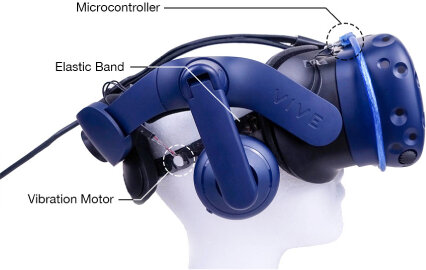
WalkingVibe applies vibrotactile cues behind the ears, synchronized to footsteps, to reduce VR sickness and to increase the realism of walking experiences in VR.
[2020/10] We presented StrengthGaming, a new approach to turn repetitive and monotonic strength training motions to control popular games at MobileHCI 2020.
[2019/12] Exhausting but rewarding serving as Subcommittee-Chair for CHI 2020. Thanks to Nic Marquardt for sharing his experience as SC from last year and working together on the ITDM/UIST sub-committee.
[2019/5] We presented PersonalTouch at CHI 2019, which improves touchscreen usability by recommending the most optimal (iOS) accessibility settings among the millions of possible combinations of settings.
[2019/2] Prof. Lung-Pan Cheng joins our department and the HCI Lab (now in R336). Drop by to say hi anytime.
Overview
My research focuses on future user interfaces, at the intersection of human-computer interaction (HCI), artificial intelligence (AI), design, psychology, and mobile/wearable/VR/AR systems. Our work has been featured by Discovery Channel, Engadget, TechCrunch, EE Times, New Scientist, Fast Company, and more.
Recent highlights include CHI Best Paper Awards 🏆and Honorable Mention Awards 🏆, UIST Best Talk Award 🏆, and 科技部吳大猷研究獎 Outstanding Young Researcher Award 🏆. My full publications at CHI, UIST, MobileHCI, and SIGGRAPH are on ACM Digital Library and Google Scholar (citations: 13000, h-index: 45).
I’m sub-committee co-chair (SC) for ACM CHI 2020 in Hawaii and ACM CHI 2021 in Japan. I also organized ACM MobileHCI 2019 conference as program co-chair, (Taipei, Oct 1-4, 2019), in addition to serving as Awards Committee members and Associate Chairs for CHI, UIST, Ubicomp, WWW, SIGGRAPH Asia, USENIX ATC, etc.
Recent Highlights
Haptic Feedback (AR & VR)
DrivingVibe (MobileHCI 2023)
TurnAhead (CHI 2023 Honorable Mention Award 🏆)
AirRacket (CHI 2022 Best Paper Award 🏆)
HeadWind (CHI 2022)
MotionRing (UIST 2021)
JetController (CHI 2021, open source @ Github)
HapticSeer (CHI 2021 Honorable Mention Award 🏆, open source @ Github)
HeadBlaster (SIGGRAPH 2020 Technical Paper & ACM Transactions on Graphics)
Miniature Haptics (CHI 2020 Honorable Mention Award 🏆)
WalkingVibe (CHI 2020)
PhantomLegs (IEEE VR 2019)
Interaction and Visualization (AR & VR)
Strength Training meets Gaming (MobileHCI 2020)
PeriText (IEEE VR 2019)
SpeechBubbles (CHI 2018)
ARPilot (MobileHCI 2018)
Smart Glasses for Game Controls (CHI 2015)
Accessibility & Ergonomics
PersonalTouch (CHI 2019)
ActiveErgo (CHI 2018)
AI meets Strength Training
MuscleSense (TEI 2020)
Circuit Prototyping and Debugging:
CircuitSense (UIST 2017)
CurrentViz (UIST 2017)
Mobile and Wearable User Interfaces:
Nail+ (MobileHCI '16)
SwipeKey (MobileHCI '16)
Backhand (UIST '15)
EyeProtector (MobileHCI '15)
PalmGesture (MobileHCI '15)
PalmType (MobileHCI '15)
Giggler (ACM Multimedia '15)
iCAN (IJHCI '15)
Tangible Interaction:
FlickBoard (CHI 2015)
WonderLens (CHI 2015).
Summer interns
We host summer interns through the university research+culture summer internship program.
想做出有影響力的研究? 想申請美國 Top 10 的研究所? 想進矽谷的 startups? Do you "work hard, play harder"? 我們從使用者體驗出發做跨領域的研究,融合設計思考、人工智慧、心理學、加上軟硬整合來實做出創新的人機介面與應用。
我們行動與人機互動實驗室曾受國際媒體 Discovery Channel, TechCrunch, Engadget, EE Times, New Scientist 報導過。學長姐們進 UC Berkeley, Stanford, CMU, UW, UCLA, Cornell, HPI, Columbia, Michigan 等研究所深造、創業、以及加入 Google, Facebook, Mediatek, TSMC, Yahoo, etc.
Classes
[2024S] Advanced HCI Class
[2023F] VR Game Programming class
[2023S] Advanced Human-Computer Interaction (AHCI)
[2022F]
[2022S] Advanced Human-Computer Interaction (AHCI) class (course listing)
[2021F] VR Game Programming course jointly with NTUST Design School.
[2021S] Advanced HCI course on VR haptics @ R110.
[2020F]
VR Game Programming class (class listing)
HCI + Design class (class listing)
[2020S] Advanced HCI class on VR haptics
[2019F] Game/VR Programming class (class listing).
[2019S]
Intro to Human-Computer Interaction and Design (course listing)
Design Thinking for User Experience Design – how to design, prototype, and evaluate user interfaces, and important topics for building natural, effective, and intuitive interfaces. (Motivated students with limited coding experience welcome.)
Advanced Human-Computer Interaction (course listing)
Advanced topics in HCI research for those interested in researching and developing novel user interaction design and technologies.
[2018F] Mobile Human-Computer Interaction 行動電話人機互動 (course listing)
[2018S]
Mobile Programming 行動電話程式設計 (course listing)
Advanced Human Computer Interaction (AHCI) 高等人機互動 (course listing)
[2017F] Mobile Human Computer Interaction (MHCI) 行動人機互動 (Course listing)
Focusing on Augmented Reality and iOS ARKit programming
[2017S]
Advanced Human Computer Interaction (AHCI) 高等人機互動 (Course listing)
Game Design 遊戲設計 (Course listing)
Contact
R336, Department of Computer Science
National Taiwan University
<mikechen AT csie.ntu.edu.tw>
EDUCATION
PhD in Computer Science, UC Berkeley
Certificate in Management of Technology, Haas School of Business, UC Berkeley
ACADEMIC SERVICES
Journals Chair: CHI 2025
Sub-committee Chair: CHI 2021 & 2020
Program Chair: MobileHCI 2019
Best Paper Awards Committee: CHI, UIST, MobileHCI
Publications
Google Scholar (citations: 13000)
ACM Digital Library
PROFESSIONAL
Ludic Labs
Intel Research
IBM Research